
Sixty Seconds
in Missoula
The Montana Knife Company launch is the most complete demonstration of linear commerce ever executed by an American manufacturer. Here is exactly how they did it and who built the machine underneath it.
The largest drop in company history, gone before 7:01 p.m.
Roughly 2× the spec-sheet comparable folder.
Bootstrapped from a garage. No outside funding, no Amazon.
Five and a half feed posts per day: 65 about the knife.
get the complete teardown.
This is a teardown of the best product launch we have seen from a DTC brand. Not the best this year; the best.
At 7:00 p.m. Mountain Time on June 4, 2026, a Shopify store in western Montana turned its inventory live. By 7:01, it was gone.
One customer described the experience in the comments of the sellout announcement: the email arrived at 7:00 on the dot. He clicked the link immediately, added the product to his cart, and by the time the checkout tried to process, the product was sold out. Total elapsed time: about sixty seconds. The product was a $390 pocket knife. Nobody at MKC was speechless by accident.
I the twenty-year delay.
The single most instructive fact about Montana Knife Company is a piece of paperwork filed with the State of Montana in the year 2000. Josh Smith registered the name "Montana Knife Company" when he was nineteen years old. He did not use it until he was thirty-nine.
By nineteen, Smith was already the youngest Master Bladesmith in the world, a certification roughly eighty living people held. The origin story is Norman Rockwell by way of Field & Stream: a knife under the Christmas tree in 1992, a Little League coach with a forge who invited the eleven-year-old into his shop.
Here is what the waiting looked like. Smith worked as a journeyman lineman for the power company. Nights and weekends, he made custom Damascus-steel knives selling for $4,000 to $5,000 each. And while he waited, he watched his industry leave the country — Schrade, Smith & Wesson, Winchester offshored one by one. The middle of the market, a quality American-made knife at an attainable price, hollowed out entirely. That hollowed middle is the entire strategic thesis of Montana Knife Company.
The catalyst was a person, not a market condition. In 2020, Smith met Brandon Horoho, a marketer with more than 1,500 product launches of pattern recognition. On December 30, 2020, Smith walked away from the union lineman job, mid-pandemic, with a garage and a twenty-year-old business name. Four years later: $50 million in revenue. No outside funding, no Amazon. One channel, one website, one audience that believes.
Smith didn't found a knife brand. He founded a re-industrialization argument with a product attached and twenty years before 're-shoring' became a term of art. The macro caught up to the man.

II the machine.
Consider what MKC actually is, operationally: as much a content studio as it is a factory. The YouTube channel runs long-form documentary work and the Instagram account publishes at a cadence that would exhaust most dedicated media companies. The email list functions as the company's demand ledger. Operationally speaking, the product ships on Thursday nights, in limited drops, and it sells out, so reliably, for so long, that the sellout itself became the brand's core content format.
Every "SOLD OUT" post is an advertisement for the next drop. Scarcity generating media generating demand generating scarcity, a flywheel with no paid-acquisition motor anywhere in the assembly.
Most brands discount because their demand is rented. MKC's demand is owned. Which is why, entering a new category for the first time in its history, it could do what almost no manufacturer on earth can do: charge a premium for the expansion itself.
III the knife.
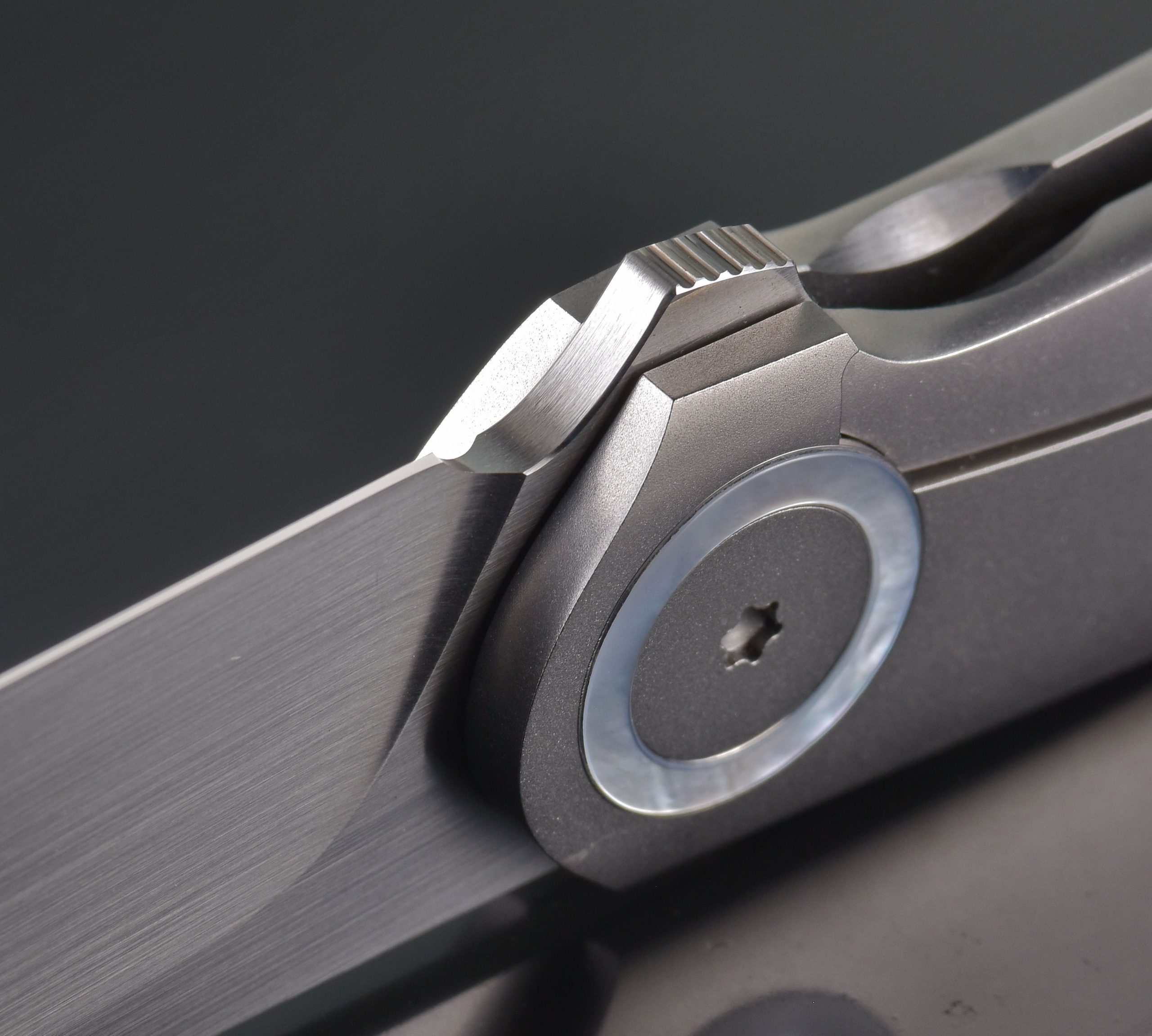
The Montana is MKC's first folding knife. For five years, the company built its franchise entirely on fixed blades. A folder is a different engineering discipline altogether: pivots, detents, lock geometry, tolerances measured in ten-thousandths of an inch. Smith had been asked about a folder for years and gave the same two-word answer every time: it's coming. What came is a liner-lock EDC folder built around CPM MagnaCut, ground to the thinnest edge MKC has ever produced and built, per Smith, to be used and handed down like every other knife they make.
Price: $390. The knife press noted, correctly, that comparable MagnaCut folders from Spyderco, Benchmade and Civivi cover similar functional ground at roughly half that number. That delta (the twofold price over spec-sheet-equivalent competition) is the most important number in this case study as it is the market's real-time appraisal of five years of audience building.
Brand equity is an abstraction right up until a company expands into a new category, prices at 2× the comparable, and clears inventory in sixty seconds. Then it is an asset with a measurable yield. MKC discovered exactly that, in front of everyone, at 7:01 p.m. Mountain Time. But the knife did not sell itself out. The company's goodwill, the reputation, and the campaign did, and we believe it deserves to be studied the way film students study a Chris Nolan sequence, shot by shot.
IV the thirteen days.
Reconstructed from MKC's public output: the emails, the landing pages, the product page, the social feeds, the video work, and the press record. The precision of the sequencing is the point. Nothing here is improvised.
The factory is the trailer
Grand opening of the 50,000 sq ft Missoula facility. Almost nobody understood they were watching the first scene of a product launch; the factory was the pre-answer to the question every sellout raises: can you make more? Infrastructure as narrative. The building was the trailer.
The Easter egg era
The knife begins appearing, unannounced, unacknowledged, in Brandon Horoho's pocket. Speculation threads form; screenshots circulate. For a full week, MKC's most engaged customers manufacture the anticipation themselves, for free. There is a name for this in entertainment: a cold open.
The announcement
The first official post lands, and with it an earned-media wave: GearJunkie, Gear Patrol and BLADE Magazine publish inside a seventy-two-hour window, embargo-style, hands-on units already in reviewers' pockets. The offer: June 4, 7:00 p.m. Mountain. Limited quantities. A date and a scarcity and that's the entire offer.
Saturation
71 Instagram feed posts in thirteen days with 65 about The Montana. A broadcast schedule, not a content calendar. The casting: Cameron Hanes, Derek Wolf, John Dudley, Sydnie Wells. Not one rented celebrity; every name endemic to the tribe. Depth, not breadth; depth is what clears inventory in sixty seconds.
The documentary
A multi-part YouTube documentary about the making of the knife, serialized so the final installments land in the last days before June 4. Content as countdown clock, the drop as season finale. People don't set alarms for products. They set alarms for endings.
Drop day
The masterstroke happens before the public can spend a dollar: an all-employee townhall at the factory, every employee gifted a Montana, the entire team watching the drop go live together from the factory floor. The first customers were the makers. At 7:00 p.m., inventory goes live. The largest drop in company history is gone before 7:01.
"We Will Make More..."
Within twenty-four hours, Josh Smith emails under that subject line, not a sales flow, a Master Bladesmith's promise backed by the visible fact of the factory. Mass disappointment converted into a signed IOU. June 17: restock signups open. July 17: a second drop announced for July 30. Each restock is a fresh launch aimed at a pre-qualified, pre-committed list.
60 seconds
The aftermath
Traffic that would qualify as a denial-of-service attack anywhere else hit a single product page at a single second and everything worked.
V the people underneath.
Now let's talk commerce infrastructure. A sellout in under sixty seconds is a marketing triumph only if the infrastructure holds. The same minute that makes the legend can just as easily produce the other story: the crashed checkout, the oversold inventory, the double-charged cards, and the inevitable apology email. The line between the two is drawn entirely in the platform and the engineering, and it held because of two parties whose names belong in this story.
The industry writes endlessly about founders and CMOs; the operators who make the machine actually fire on time remain uncredited. Not here. MKC is a company whose entire identity is manufacturing excellence, and when it chose its digital infrastructure, it applied the same standard.
The website was built the way the knives are built. That coherence, the same value system running from the grinding room to the checkout, is the deepest reason the sixty seconds held.
VI what this launch actually teaches.
Strip the romance away and The Montana campaign resolves into five transferable principles. None requires a knife, a factory, or a Master Bladesmith. All require discipline that most organizations do not have.
The audience is the asset; the launch is the harvest. MKC ran a five-year campaign whose thirteenth-day expression was a sellout. If your brand cannot move product with an email and a post (no discount attached), you have an audience problem, and it precedes everything.
Scarcity must be load-bearing. MKC's scarcity is real a factory has a weekly capacity, and the company sells to it. The audience knows the constraint is genuine, which is why it creates energy instead of resentment. Honest scarcity compounds. Artificial scarcity decays.
Price the expansion at the brand, not at the spec sheet. Category expansion is the one moment a company gets a clean, public read on what its brand is actually worth. MKC priced at 2× the comparable and got its answer in sixty seconds. If you have spent years building equity, the expansion is when you collect on it.
Launch inward before you launch outward. The employee townhall cost almost nothing against the campaign and generated its most valuable asset: sentiment that cannot be faked, filmed at the source. A company's employees are its first audience and its most credible broadcasters.
The infrastructure is the campaign. Sixty-five posts drive traffic to one URL at one second. Everything upstream of that click is marketing; everything downstream is engineering; the customer experiences them as a single thing. If your best marketing day ever arrived tomorrow at 7:00 p.m., would your stack survive it?
VII coda: the deterministic launch.
The era of cheap, probabilistic growth is over, so is growth as a slot machine with a Meta login. What replaces it is what MKC has been quietly building since 2020: deterministic demand. What does that look like? An owned audience of known size, a drop calendar of known cadence, a factory of known capacity, and an email list that functions as a forward order book. When MKC schedules a drop, the outcome is not a hope; it is nearly an arithmetic.
That is what observers watched on June 4. Virality is luck wearing a suit; that's not what this was. You watched a company that had made its own demand predictable, then compressed five years of it into sixty seconds as a demonstration of the fact.
Josh Smith waited twenty years to use a name his nineteen-year-old self registered, because the name deserved a machine behind it. The machine took five more years, a partner from South Carolina, an eCommerce director in Pittsburgh, an esteemed Shopify agency in Chicago (Ethercycle), seventy-one Instagram posts, one documentary, one townhall, and one factory in Missoula.
The consumers weren't ready. None of us were; the knives were gone in sixty seconds and that was the mission.