
Engineering a
Membership-Driven
Platform
Bandit Running
Membership Platform Architecture Commerce Infrastructure Shopify + Middleware Engineering Partner Network Systems
The Challenge
At the consumer level, Bandit’s membership program is aggressive by design. For $125 per year, members receive immediate economic advantage: a standing 10% discount, free shipping on every order, escalating annual digital gift cards, exclusive releases, early access windows, recurring physical goods, and deep partner benefits such as 20% off ASICS footwear, ongoing credits at The Feed, preferred pricing at CitizenM hotels across 36 global cities, and discounts with Hyperice, Eight Sleep, Autocamp, Ketone-IQ, and dozens more. The company is explicit in its promise: the membership is “mathematically designed for you to be immediately in the green.”


Bandit did not engage MTN Haus to build a website. They engaged us to help construct the operating system of their business.
Bandit’s leadership believed the company’s future would be defined not by transactions, but by membership — a living economic ecosystem built on benefits, partnerships, experiential access, financial incentives, and long-term customer relationships. Their ambition was to create one of the most value-dense membership programs in performance retail: standing discounts, universal free shipping, escalating annual gift cards, exclusive product access, early releases, and a rapidly expanding partner network spanning footwear, travel, wellness, recovery, nutrition, and hospitality.
The challenge was that this business model could not exist on standard eCommerce infrastructure.
MTN Haus was engaged to design and engineer the full commerce platform capable of operating this system at scale.
What Bandit lacked was the infrastructure to operate this promise at the levels that it wanted to.
Membership logic was too complex for native Shopify. Benefits were conditional. Eligibility was dynamic. Cashback required delayed activation and fraud controls. Partners ran on independent platforms and POS systems. Members needed seamless redemption both online and in physical locations. Internal teams required full real-time operational control.
This was not a website problem. It was a commerce systems problem.
Discovery + Architecture
MTN Haus began with a comprehensive discovery and architecture phase. Stakeholder interviews aligned leadership, product, and operations around a unified growth thesis. Market analysis contextualized Bandit’s differentiation. Technical audits exposed the limits of existing tooling. The result was a full architectural blueprint defining data models, system flows, security boundaries, API requirements, and a phased delivery plan that could convert business ambition into executable systems.
| business constraint | architectural decision | strategic result |
|---|---|---|
| Membership too complex for native Shopify | Introduced custom middleware as system of record | Shopify remains stable while business logic evolves |
| Manual operations scaling poorly | Built full internal admin platform | Increased operating leverage |
| Partner expansion causing fragility | Designed modular partner engine | New partners onboard without re-engineering |
| Cashback & benefit abuse risk | Delayed activation + eligibility enforcement | Margin protection |
| Rapid program evolution required | Programmable benefit framework | Business model agility |
System Architecture Overview
The platform was engineered across three coordinated layers:
- Shopify Plus: customer identity, checkout, storefront, member UI
- MTN Haus Middleware: centralized business logic, benefits, cashback, wallets, transactions
- Admin & Operations Platform: internal control plane
This separation allows Bandit’s business model to evolve without destabilizing its commerce engine.
| option | why it failed | why mtn won |
|---|---|---|
| Off-the-shelf loyalty apps | Could not support conditional benefits or partner rules | Custom system preserved business model |
| Headless rebuild | Added cost & risk without need | Shopify provided stable commerce surface |
| Single backend monolith | Hard to scale, high blast radius | Modular middleware architecture |
| Direct partner integrations only | Fragile & bespoke | Central partner engine scales cleanly |
Membership Experience: Turning Shopify Into a Platform
MTN Haus transformed Shopify’s customer account area into a complete membership dashboard. Members now experience their entire economic relationship with Bandit in one interface: membership status, benefits, cashback (Pending → Active), digital wallet balances, partner offers, redemption tools, and real-time eligibility enforcement. Data flows continuously between Shopify and middleware through secure APIs and webhooks, ensuring that every view reflects live business state.
This conversion of Shopify from storefront to membership gateway is foundational to Bandit’s growth strategy.
Admin & Operations Platform
To operate the system at scale, MTN Haus delivered a custom internal platform that functions as Bandit’s operational cockpit:
This platform replaces fragile manual workflows with governed, programmable control.
- Member Management
- Benefit Creation & Governance
- Cashback Monitoring
- Wallet Credit Oversight
- Partner Management
- Transaction Logging
- Authentication & System Settings
| risk | system safeguard |
|---|---|
| Cashback abuse via returns | Pending → Active return windows |
| Unauthorized benefit access | Real-time eligibility enforcement |
| Partner discount leakage | Unique member-specific codes |
| Partner outages | Middleware retry + failure logging |
| Data inconsistency | Centralized system of record |
| Program sprawl | Admin-governed benefit creation |
This has quietly become one of the most
valuable parts of being a Bandit member.
member of the Bandit community
Partner Commerce Engine
Bandit’s growth depends on its partner ecosystem. MTN Haus built a v1 Partner Commerce Engine that supports Shopify partners, physical retail partners, and future platform expansion. Integrations include discount code lifecycle management, redemption validation, cashback tracking, delayed activation windows, fraud controls, QR and text-based in-store redemption, standardized onboarding documentation, and partner configuration workflows.
Each partner can be onboarded without destabilizing the core platform.
Middleware: The System’s Backbone
The custom middleware layer handles all business logic that Shopify cannot. It calculates benefits and cashback, enforces redemption rules, manages wallet balances, records transactions, synchronizes data, handles failures, and monitors system health. It includes performance optimization, caching, historical data migration, structured schemas, observability, and automated alerts.
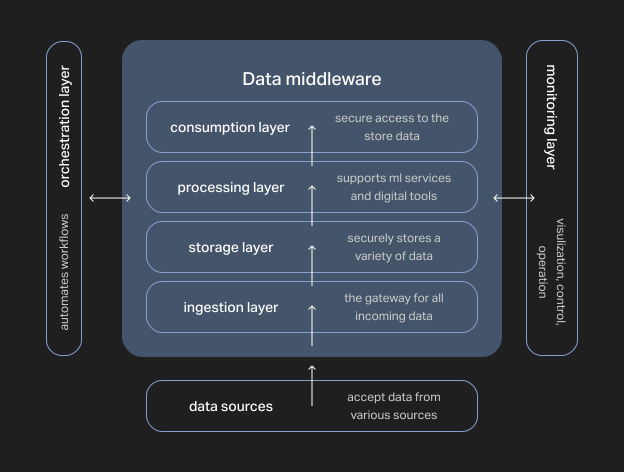
In practical terms, this middleware is the platform.
Delivery Model
Execution followed MTN Haus’ delivery framework: discovery, design, engineering, integration, QA, UAT, launch, and stabilization, with continuous stakeholder alignment throughout the six-month build.
Outcomes & Competitive Advantage
While financial metrics remain confidential, Bandit emerged with a fully operational membership commerce platform, a scalable partner ecosystem, disciplined operational governance, and a future-proof technical foundation. Let’s explain it in runner’s terms, as well.
MTN Haus Engineering
x Bandit Running

| dimension | before mtn haus | after mtn haus |
|---|---|---|
| Membership Logic | Fragmented | Centralized |
| Partner Management | Manual | Programmatic |
| Data Flow | Batch & brittle | Event-driven |
| Fraud Controls | Reactive | Preventative |
| Growth Cost per Partner | High | Low |
| Operating Leverage | Limited | Compounding |

Runner Accelerating
| growth axis | platform behavior |
|---|---|
| New Benefits | Configured without engineering |
| New Partners | Standardized onboarding |
| New Geographies | Region-based benefit logic |
| New Revenue Streams | Wallet & benefit engine already in place |
| New Product Lines | Native Shopify compatibility preserved |

VO2max Improving
| signal | what it communicates |
|---|---|
| Membership OS, not website | Deep platform engineering |
| Shopify preserved | Low technical risk |
| Partner engine modular | Long-term scalability |
| Programmable economics | Strategic agility |
| Unified control plane | Enterprise readiness |

RHR Falling
Bandit now operates not as a brand with a membership program, but as a membership-driven commerce platform whose infrastructure compounds advantage as the business grows.
In The Spotlight


Coming Soon
- Migration
- Website Development
- App Development

- Headless
- Webflow
- Middleware


Coming Soon

Coming Soon
- Custom Development
- UX Design
- Integrations

Coming Soon
- Custom Theme Development
- UX Design
- Product Configurator


Coming Soon
- Migration
- Custom Development
- Integration


Coming Soon
- New Shopify Build
- UX Design
- Branding